
Blog

Abby Breckenridge

Marketer by trade and manager by passion, Abby has made it her mission to empower her team so they can deliver their best work to clients. She prefers working with whole people who aren’t afraid to bring their creativity to the table.

Partner | LinkedIn
Credibility stands out in a sea of generic B2B content 

02/20/2026

Credibility stands out in a sea of generic B2B content 

By Abby Breckenridge

Credibility stands out in a sea of generic B2B content 

Image by Rachel Adams

Our clients are smart. They market cutting-edge products, which means they’re always looking for new ways to make their efforts more effective. So the line of questioning we hear most consistently from them is: what’s working? What are your other clients doing? What’s hot in B2B tech marketing?

Right now, the answer is letting real experts speak directly to buyers. Not brand voice, not canned demos, not vague thought leadership—but credible, knowledgeable people who clearly know their domain and aren’t afraid to say something specific.

Buyers are overwhelmed. Social media feeds and inboxes are flooded with generic content, most of it interchangeable and written to satisfy an algorithm. In that environment, content that clearly came from a real person with real experience immediately stands out. When buyers hear from someone who has hands-on expertise, like an engineer, a product leader, or a satisfied customer, they’re more likely to pay attention and trust what they’re hearing.

This approach works across a range of formats. We’re seeing strong performance from:

  • Written case studies that go beyond surface-level metrics and include expert commentary on how and why results were achieved
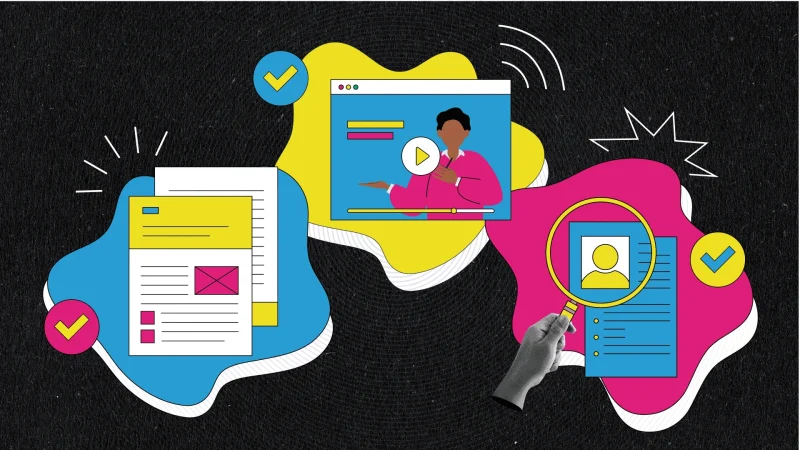
  • Video case studies where customers or internal experts speak plainly about challenges and outcomes
  • Engineer-driven blogs that explain architectures and the reasoning behind decisions
  • Founder or executive POV pieces with anecdotes that reflect lived experience
  • Original research with new takes and insights

Credibility is what wins today. When customers are looking for reasons to believe, the most persuasive marketing isn’t louder—it’s grounded in real expertise and feels more specific and human.

Great marketers don’t panic, they pivot

01/29/2026

Great marketers don’t panic, they pivot

By Abby Breckenridge

Great marketers don’t panic, they pivot

Image by Rachel Adams

“2A is great, they don’t freak out.”
I overheard a long-time client say this to a colleague while convincing her that our creative agency was the right team to help get an executive keynote presentation across the finish line.

It made us laugh, and it perfectly captured something I’ve come to value in marketers. Whether I’m hiring for our creative agency or helping our recruiting and staffing clients build their own teams, I look for candidates who are flexible. In other words, they don’t freak out.

A lot can change over the course of a tech marketing initiative. Executive priorities shift. Tools and channels gain or lose effectiveness. And we’ve all seen AI reshape workflows that, not long ago, were considered best practice.

Great marketers aren’t overly attached to any single tool or tactic—they stay focused on outcomes. When something stops working, they test, learn, and adjust without panic.

Translating change into opportunity 

Product change adds even more complexity. In tech, features are added, removed, or repositioned frequently as roadmaps evolve in response to customer needs and competitive pressure. Marketers who struggle with change risk misalignment and missed opportunities. The strongest ones stay close to the product, translate updates into customer value, and evolve the story without unnecessary friction.

This doesn’t mean the fundamentals don’t matter. A deep understanding of marketing principles, the ability to tell a compelling story, and a strong grasp of the product and/or industry are still essential. But on top of that, the best marketers quickly absorb new information and evaluate how it changes their course.

When you’re hiring a marketer, look for the ones who can adapt, recalibrate, and move forward confidently. Your team (and your customers!) will thank you.

Illustration of a pie chart with arrows highlighting segments, surrounded by icons of a calendar, dollar sign, user profile, and webpage, symbolizing data-driven marketing strategy.

10/28/2025

How fractional work is helping B2B tech companies grow   

By Abby Breckenridge

Illustration of a pie chart with arrows highlighting segments, surrounded by icons of a calendar, dollar sign, user profile, and webpage, symbolizing data-driven marketing strategy.

Image by Nicole Todd

I’ve been noticing more friends taking on fractional roles. Maybe it’s because the fractional model is catching on with businesses looking for access to skills and experience they may not be able to afford full-time. Or maybe it’s because a lot of my cohort have hit the point in our careers where we’ve racked up some real experience, and now we get to use it in more flexible ways. Either way, fractional leadership is having a moment, and for growing companies, it’s a game-changer. 

Fractional hires bring leadership without the long-term commitment 

A fractional executive is a seasoned leader who joins your team part-time—usually a few days a week or for a defined project—to bring executive-level strategy and oversight without the full-time commitment or investment. Think of them as your interim CMO, COO, or Chief of Staff who can quickly understand your business, set direction, and build momentum. 

They’re a good fit for growing B2B tech companies 

Fractional executives fill that tricky middle space: you’ve outgrown one-person-does-it-all leadership but aren’t ready for another full-time seat at the table. Or maybe you have budget for one full-time executive, but you need support that spans a few roles.  
Fractional hires can: 

  • Bring outside perspective. Because they work across companies and industries, they bring playbooks with proven outcomes and fresh ideas you won’t get from inside your business’s bubble.
  • Flex with your goals. As your needs change, their involvement can scale up or down. It’s executive leadership on demand.
  • Bridge the gap during transitions. Whether you’re between full-time hires or expanding into new markets, fractional leaders can provide steady, experienced guidance when continuity matters most. 

We can help   

At 2A, we’ve seen the power of fractional leadership firsthand. Or another way of putting it, we’ve been doing it since before it was cool. We’ve been placing temporary teammates in strategic roles for years, and our network is only getting stronger. We can give you access to marketing and operations professionals who’ve guided companies through change, challenge, and scale. We can help you find the right fractional fit—someone who can start strong, move fast, and make things happen. 

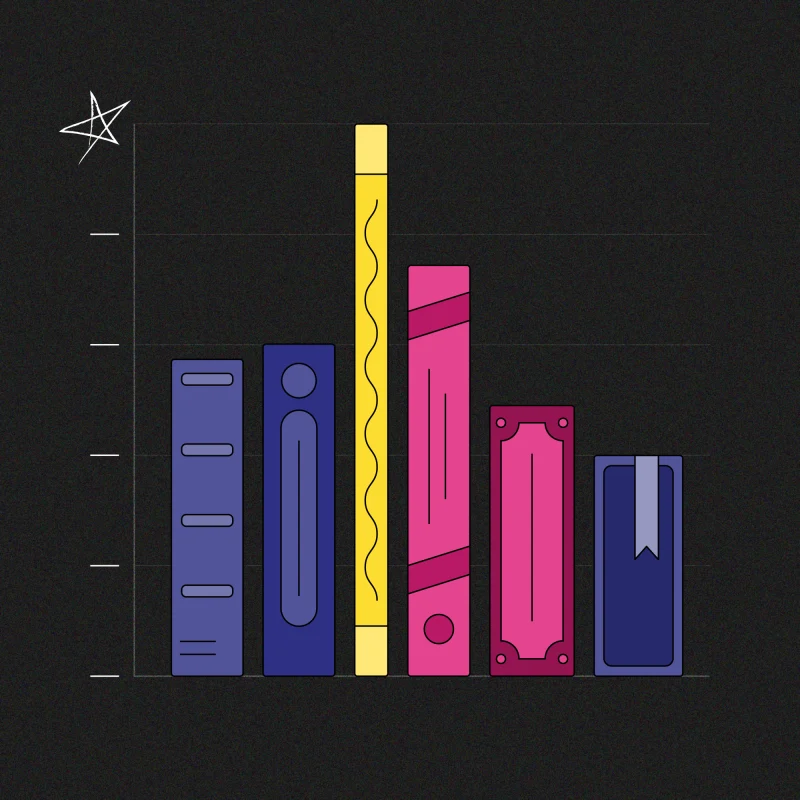
Illustration of colorful books arranged like a bar chart on a dark background, symbolizing data-driven storytelling or impactful eBook creation.

10/22/2025

Shorter ebooks can deliver more impact 

By Abby Breckenridge

Illustration of colorful books arranged like a bar chart on a dark background, symbolizing data-driven storytelling or impactful eBook creation.

Image by Emily Zheng

As the owner of a creative agency, I’ve always believed in pricing based on value, not effort. Or to put it another way, pricing marketing assets by the hour feels backwards. Why should a client pay more because something took longer? I’d pay more to have it done today. That’s the difference between effort and outcome. 

The same logic applies to ebooks—longer is not better. In B2B marketing, ebooks can play an important role: they explain complex ideas, answer objections, and help generate leads. But if you can convince your prospect to move down the funnel in four pages, then there’s clearly no need for six. The goal is clarity and impact, not length. 

Here’s why a shorter ebook might be exactly what your demand generation campaign needs.  

Shrinking attention spans 

Your buyers don’t have the time, or patience, for bloated ebooks. Between inbox overload, back-to-back meetings, and constant digital noise, the odds of someone finishing a 12-page ebook are slim. Most people skim. Many never make it past the intro. The reality is that readers are busy and distracted, and value per page matters far more than page count. A concise ebook that delivers value early is far more likely to be read, remembered, and shared. 

Perceived complexity 

Longer ebooks don’t just test attention, they can also make your topic feel harder than it really is. When readers see too many pages, they assume the subject requires a steep learning curve or that your solution is complicated to use. A shorter, well-structured ebook sends the opposite signal: this is approachable, clear, and worth their time. 

Thought leadership in the age of AI 

AI can generate thousands of words at lightning speed, but it can’t generate authentic perspective. This is where true thought leadership comes in. B2B buyers don’t need long-winded rundowns; they want sharp, differentiated insights. The best ebooks highlight your expertise, connect the dots, take a position, and say something original. A four-page ebook that sparks a lightbulb moment will always outperform a 15-page summary that says what everyone else is saying.  

Of course, not every ebook should be short. There’s a place for longer assets that dive deep into technical specs, step-by-step how-tos, or detailed guides for do-it-yourself readers. Those meaty resources are valuable when your audience is ready to roll up their sleeves. But for demand generation and thought leadership, shorter content almost always wins. 

Build less and say more 

A tight, well-structured ebook isn’t easy to write. It takes a sharp team of marketers and product experts to distill complex ideas into a clear story. Next time you’re tempted to throw more pages at your marketing challenge, ask if they’re truly adding value. And before you start generating content, make sure you have the right team in place to define a differentiated story. Need a hand? We’re here to help

Why kindness is our best recruiting strategy 

10/03/2025

Why kindness is our best recruiting strategy 

By Abby Breckenridge

Why kindness is our best recruiting strategy 

Image by Jenni Lydell

“What are you doing right?”  

It’s what my friend and fellow business owner asked me a few weeks back after I explained that our recruiting and staffing practice had taken off over the last year. In simple terms, I realized it’s because we’re kind. As a small player in an industry where scale often overshadows individuals, we’ve backed into a differentiator that I love.  

By kind I mean we know all our team members that are embedded in other companies, and we check in with them regularly. We offer good benefits, paid time off, and morale boosters. We negotiate on their behalf for raises when they’re due, and we research and cover training to boost them along their path.  

Lucky for us, we’re noticing a trend—clients are recognizing the gap left by larger staffing firms, where contract employees feel more like a line item than a human. Our recruiting and staffing clients, the ones that work daily with the skilled (and human) folks that we employ and place in roles with them, want to be sure their team is well taken care of. And they’re not finding that at the global staffing firms where procurement algorithms select talent agencies for their low margins. Increasingly, they are turning to boutique agencies that prioritize well-being and meaningful connection. 

As a human, I’m thrilled that what we’re doing right is treating our team with kindness. As a business owner, I’m also thrilled.  When employees thrive, clients benefit from stability and engagement, and agencies stand out for the right reasons. In a competitive industry, kindness isn’t just good—it’s strategic. 

Collage-style graphic showing a bright yellow AI brain icon with circuit patterns, surrounded by illustrated hand tools like a saw, hammer, screwdriver, and pliers. Two realistic hands point and interact with the brain, set against a dark blue grid background, symbolizing the intersection of technology and craftsmanship.

05/08/2025

AI is a tool, not a trade-in for people 

By Abby Breckenridge

Collage-style graphic showing a bright yellow AI brain icon with circuit patterns, surrounded by illustrated hand tools like a saw, hammer, screwdriver, and pliers. Two realistic hands point and interact with the brain, set against a dark blue grid background, symbolizing the intersection of technology and craftsmanship.

Image by Nicole Todd

What trends am I seeing for spring? Butter yellow, oversized blazers, and asking marketing agency owners how they’re using AI. 

It’s a good question—and certainly one that no self-respecting agency leader is ignoring. It’s just that the hype levels have gotten a bit, how shall we say it, inauthentic. 

So here’s my answer: we’re embracing AI as a tool to help us do the work our clients need better and faster! And we’re doing it in a way that aligns with our values

Here’s what I mean: 

We’re helpful. We’re using AI tools in ways that are helpful to us and our clients. When it gets work done faster and better? Then it’s an AI yes. We’re using AI to help us parse resources more thoroughly, brainstorm 25 header options instead of 10, and check for the right voice and tone throughout content. 

We’re serious about our work. Our clients choose us for our high-quality deliverables and smooth client experience, and we’re serious about continuing to stand out in those ways. When AI helps us deeply engage with our work, we’re all in. Today, that means taking a client’s messaging framework and using gen AI to quickly create derivative assets like one-pagers, ebooks, and banner ads. The result? More content for better value. Tomorrow, it could mean something else. 

We work to build trust. Human relationships mean a lot in our business. We’re seeing many faceless offerings pop up, such as “become an AI expert in 10 days” and “accomplish your tasks at warp speed.” We maintain the trust of our clients, and in turn, their audiences’ trust in them, by using our expertise to refine work. We’re experts in our clients’ brands, their differentiators, and their customers’ pain points—so when AI spits out something off, we spot it. 

We tack toward improvement. Lucky for us and our clients, we’re a curious bunch. Our team gets excited about testing new approaches and refining based on what we learn. Gen AI tools are no different. Nothing drains a creative team faster than doing the same thing repeatedly for days on end. And the possibilities of today’s (and tomorrow’s) tools have us pumped. 

Seeking marketing assets that work, and an energizing client experience? Give us a ping. And, if you see me around town in my oversized butter-yellow blazer, please say hello. 

Thank you, Renato

10/13/2021

Thank you, Renato

By Abby Breckenridge

Thank you, Renato

Renato is leaving 2A. This is a big deal for us and comes with so many emotions.  

There is no doubt we’ll miss him. Renato started 2A on his own back in 2010, then Daniel and I joined him a few years later. It’s that entrepreneurial spirit, the sauce that emboldened him to start 2A, that we’ll miss the most. He brings the guts it takes to break out on his own, paired with the vision to see how something can be made from nothing. That, his sunny sense of humor, and his deep commitment to caring for the people around him will leave the biggest legacy.  

I’ll always remember the first time Daniel, Renato, and I got together. It was a breezy summer dinner around a fiery grill in my backyard, after Renato and I had finished the MBA program at Foster and Daniel had moved to Seattle with his girlfriend (my childhood friend). It was a lot of fun, included a lot of wine, and set the stage for the fruitful relationship we now share.  

Since then, the three of us have led 2A through countless wins and humbling challenges—a journey that looks more like a doodle than a straight line. From a team of four to almost 40. From one amazing client to over 40. From a shared room in a to-be-torn-down house, to 6,000 square feet on Capitol Hill. And from the youthful idea that all the steps are laid out in front of us to a more seasoned view that plans are just that.   

What we do know is that 2A, the team, Daniel, and I are all stronger because of Renato. We also know this change is a great move for all of us. Daniel and I will get to flex our skills in new directions as Renato’s departure, even with all the planning, will surely leave gaps. There’s an ocean of new possibilities for Renato as he unleashes his entrepreneurial spirit toward new ventures. And while our partnership in 2A is over, breezy backyard dinners around a fire will surely continue.  

4 business villains every marketer should fight

03/10/2021

4 business villains every marketer should fight

By Abby Breckenridge

4 business villains every marketer should fight

Image by Thad Allen

“But what happened that was bad?” my 5-year-old asked after I wrapped up an improvised bedtime story about a boy named Chugapie who likes to eat a lot of pies. And while his question was certainly a stall tactic, and he was probably just hoping for a sword fight instead of a child-driven, problem-solving narrative, he did have a point.

A good story needs some tension—or something “that was bad.”

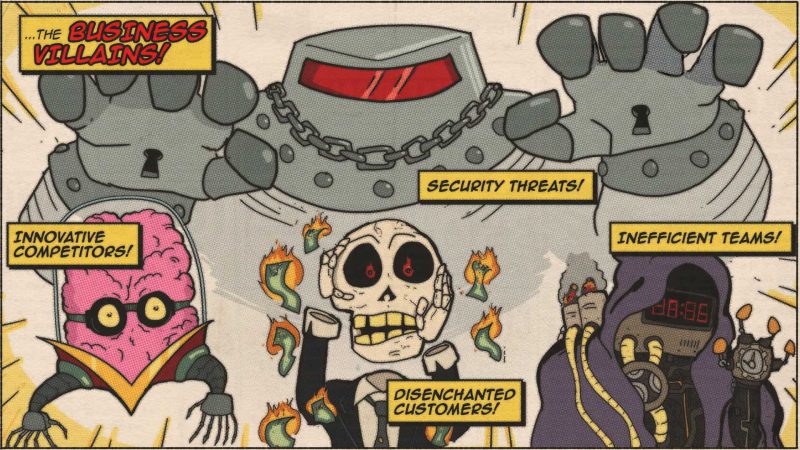
As students of business-to-business marketing, we’re well versed in the tensions that compel decision makers to act. Fear is a tested marketing lever, but the business audience has a unique set of worries. As we support our B2B marketing clients to create stories that resonate with their customers, we’ve found common themes. Here’s our short list of business villains that smart leaders pay money to avoid, and clever marketers position their products to combat.  

  • Innovative competitors—nothing spells the end like getting left behind by a business that reinvents your space.
  • Security threats—if your data is compromised, so is your future.
  • Inefficient teams—employees make the engine churn, don’t let old tools and bad training slow them down.
  • Disenchanted customers—they vote with their dollars, so you’d better make sure they’re voting for you.

Whether your business customer is looking to digitally transform or empower their team, make sure you’re offering a solution that fights their villains and smooths the arc to resolution.

A collage of film strip, smart phone, scissors, and graphical flourishes.

04/23/2020

Creating can’t-look-away videos in an era of social distancing

By Abby Breckenridge

A collage of film strip, smart phone, scissors, and graphical flourishes.

Did you have plans to create an awesome video case study for your upcoming conference, or an explainer video to tell customers how to get started? Well, your plans have been changed. In an age of distancing we’re not gathering film crews and talent to make marketing videos, it’s just not essential. But there are some good alternatives, and we’d love to help. 

Combine amateur footage with a
professional edit

We’re all spending a lot of time looking at low-quality video of our friends and colleagues talking into the computer—so lean into it. Piece together footage from customers, partners, or subject matter experts, and make a compelling story from afar. We’ll work with you on a concept, point you to some helpful equipment, prep your speakers, edit your footage, add sounds and graphics, and deliver you a final asset. You’ll be amazed at what a professional edit can do to turn your homegrown footage into a powerful, customer-ready video.

Spruce up your webcast

There’s a lot we can do to make a webcast more engaging for the viewer. And these remote events can be the perfect stand-in for that video you just can’t make right now. Start with your customer need, add an expertly crafted talk track, engaging slides, a professional voiceover, some animated transitions, and you have yourself a watch-worthy show.

Make an animation

When live-action footage isn’t available—and even when it is—animation is powerful tool to make your stories mesmerizing. Switch gears away from live-action footage and embrace the power of a well-crafted animation. Your words have more sticking power when they’re choreographed together with illustration, voiceover, and music. And your audience won’t be able to look away.

Your video plans have changed but don’t let that stop you from making a powerful marketing tool your prospects and customers can watch online.

Let’s get virtual—hosting captivating events from afar

04/03/2020

Let’s get virtual—hosting captivating events from afar

By Abby Breckenridge

Let’s get virtual—hosting captivating events from afar

Switching your in-person event to a virtual one is this season’s must-have marketing move. Everyone’s doing it. So how do you make your webinar a showstopper? Here are our top tips to ensure success.

  1. Invest in getting people there. Send multiple, targeted email invitations and drive them to an engaging registration page with clear takeaways, ideal attendee personas, well-crafted session descriptions, and presenter photos.
  2. Practice makes better. A virtual event can still run into the same logistical kinks as an in-person experience. Be sure to gather all your presenters together for a dry run beforehand, and practice hand-offs between speakers.
  3. Agree on a presenter dress code. Just because it’s virtual, doesn’t mean we can’t see you! When you have multiple presenters, it’s nice to standardize the mood so someone doesn’t show up in a robe broadcasting from their closet, then hand it off to a colleague in a tie.
  4. Anticipate more attendees. It’s far cheaper to send 30 people to an online event than on a plane across the country, so make sure you track registration counts, confirm your online meeting platform can handle high traffic, and give your IT department a heads up—nothing says failure like a mid-session app crash.
  5. Keep sessions short. People get distracted more quickly when they have the whole internet at their fingertips, so limit sessions to 30 minutes.
  6. Plan for too short. Talks tend to tick along more quickly when the speakers don’t have the energy of an in-person audience. Presenters won’t know if their joke leads to chuckles, so there won’t be pauses for laughter. In case of wrapping early, keep your attendees engaged with a fun break experience and a note about when the next session will start.
  7. Tell breathtaking stories. Talk tracks and slides will carry a heavier load than usual, so don’t skimp. Here are our tips for what’s hot in slides.
  8. Share the screen. It’s most engaging to share a visual mix of the speaker, demos, and their slides—that’ll require a producer on the backend to do it well.
  9. Be ready for questions. Attendees will still want to ask questions and make themselves known to the presenter. Use a moderator to gather and share questions or schedule a Q&A where attendees can queue up to ask in their own voice.
  10. Give your content legs. Plan to share resources like event recordings, decks, whitepapers and other related content to capitalize on the momentum.
  11. Don’t drop the marketing ball. Capture and segment all engagement, then plan your next touchpoint, whether it’s a follow-up email, a private demo, exclusive access to an eBook, or something else.

We’d love to help make your just-turned-virtual event a worthy marketing investment. From start to finish—promotion, registration pages, speaker training, talk tracks, slides, follow-up, and project management—we’ve got your back. Drop us a line.