Blog

Abby Breckenridge

Marketer by trade and manager by passion, Abby has made it her mission to empower her team so they can deliver their best work to clients. She prefers working with whole people who aren’t afraid to bring their creativity to the table.

Partner | LinkedIn
Womens' March

01/26/2017

The people’s messaging—Women’s March

By Abby Breckenridge

Womens' March

Last Saturday morning, I helped my seven and nine year old nieces finalize their protest signs before we headed to Judkins Park to join 175,000 like-minded humans in the Seattle Women’s March.

While global participation was staggering, what struck me most while shuffling down Jackson was the homegrown creativity of our community that showed up on hand-made signs, hats, and costumes. It’s true, I am partial to my niece’s “Donald Trump has a bump on his rump”, but she certainly wasn’t alone in her break-out wordsmithing.  Turns out, museums across the globe took notice as well and are collecting signs to make sure we memorialize the effort.

I can’t think of the last time I was surrounded by so many powerful messages—and so few corporate ones. As someone who spends a lot of working hours mulling over the right words to spark a reaction, I was humbled by my sister marchers’ ability to turn a persuasive phrase.

Let’s keep it up.

Meet Nick

10/26/2016

Nick Dwyer—We’re big fans

By Abby Breckenridge

Meet Nick

We run an open, collaborative office so a new personality always makes an impact. Since Nick joined the team in July, he’s been able to strike the right chord of fitting in and standing out. And while his choice of shirt may have something to do with it, there’s more to the story.

He challenges the status quo

Through his willingness to take a step back consider the unexplored, Nick opens up opportunities for all of us to be more creative. This is a huge asset to our line of work, where helping clients succeed often relies on getting your message noticed. It also may be an explanation for how his non-traditional career journey has lead him to 2A.

Before returning to his hometown of Seattle to pursue an MBA at the University of Washington, Nick spent years designing projects and writing proposals for USAID programs throughout Africa and Haiti. This work took him to big cities and rural towns in places like Liberia, Congo, and Burundi, where he interviewed underserved locals and showcased their stories in proposals for healthcare, education, and land rights projects. While working abroad he learned how to tolerate lots of ambiguity, take a bucket bath, and change outcomes through a well-crafted story.

While we’re glad Nick has traded in his frequent flyer miles for a steady job in Seattle, we know his sense of adventure and penchant for doing things differently are intrinsic to who he is.

He’s a natural born storyteller

His first foray into public storytelling started in college, where he wrote and performed in a sketch comedy group called Penguins Without Pants and became comfortable on a stage. He then put his writing skills to use and helped start a creative writing circle after college.

Whether it’s a tale about renting out a yoga studio on Airbnb as a low-cost lodging solution for a group of sports fans, meeting a childhood-hero-fortune-cookie-factory-owner through a craigslist exchange, or explaining the origin of his big fans shirt that his wife had made for him in Guinea, Nick routinely makes us laugh at Monday morning meetings with stories of his escapades. Sure, he has a penchant for adventure, but he also has a knack for finding the story and sharing it.

He has an appetite for technology

Nick came to 2A with a strong foundation in marketing, years of client management experience, and a flair for organizing information, but we thought we’d need to ramp him up on B2B technology. Think again. His ability to quickly find the kernel of value in complex products makes him a natural with our software clients. Turns out, he cut his teeth at a large aerospace and defense technology contractor, where he worked to translate the dry specifications of high-tech products into value messaging.

All that is to say we’re big fans of Nick Dwyer. Once you get to know him, we think you will be too.

Find the nugget

08/24/2016

4 steps to becoming a feedback front-runner

By Abby Breckenridge

Find the nugget

I’ve been looking for a reason to visit the recently renovated School of Visual Concepts, and certainly didn’t think it would come as an opportunity to speak with young designers about leadership. But that’s exactly what I got to do last Friday at an AIGA Emerge event—part of a national campaign to strengthen offerings for emerging designers.

My message? Feedback is a muscle that needs building and you’d better head to the gym if you want to grow in your career. And while giving feedback is certainly as important as receiving it, the early phases of our careers are weighted towards the receiving end, so that’s where I focused.

1.  Make space to hear it

If you’re too caught up in your own emotional response, you’ll miss the chance to grow. Calm that inner ego for a moment and make the emotional space to take in what you’re hearing.

2.  Find the nugget in what you hear

Not all feedback is good, or well explained, but there’s almost always a nugget in there that will make your work stronger. Ask questions. Think it through.

3.  Scout a way forward

Don’t get stuck and figure out what’s next. A new concept? A revision? A different deliverable? We’re making work that has purpose. It’ll never happen if we’re stuck.

4.  Recommit to the new vision

Find something you care about in the new path give it your all—even if that inner ego you squashed in step one still has her hands on her hips.

Jonathan with Hololens

07/20/2016

Getting to know Jonathan

By Abby Breckenridge

Jonathan with Hololens

I remember Jonathan from graduate school at UW Foster School of Business, he was the president of the class behind me and Renato.

I knew then that he was friendly and charismatic—the kind of guy everyone wants to know, and who chooses to know them back. I knew he was curious, with lots of interests that made for good conversation. I knew he was ambitious, as all class presidents are, and devoted to his community.

I didn’t know then, that like me, he grew up in the northwest and would later raise a family here. Jonathan is a 4th-generation resident of Washington state. He attended tiny Nooksack High School, which is a few miles from the Canadian border and surrounded by dairy farms.

I didn’t know that he’d go on to build a rich and fruitful career in marketing, with work spanning retail, software, wireless, consumer electronics, and the emerging space of Internet of Things (IoT).  Nor did I know that Jonathan has also held a wide variety of jobs that he now refers to as “character-building”: security guard, delivery driver, barista, janitor, seafood processor, nurse’s assistant, postal service mail sorter, and produce salesperson at Pike Place Market.

And I certainly didn’t know that we’d work together at 2A, and that his thoughtfulness, creativity and domain expertise would become invaluable assets to our work.

With almost four months at 2A under his belt, we’re grateful to have Jonathan on the team. We’re learning that he’s unfailingly prepared, and that we all benefit from it. We’re getting to know that his seniority in our field spans both the subject matter of marketing as well as the life skill of understanding humans and how to work well with them. We’ve also gotten a taste of his passion for virtual reality and curiosity for disruptive technology.

You should get to know Jonathan too. Maybe he’ll help you with your launch strategy or make your messaging more customer-focused, or maybe you’ll grab a beer and talk about the possibilities of IoT. Drop us a line.

.what

03/23/2016

.what?

By Abby Breckenridge

.what

Web addresses are changing. Have you noticed? We’re no longer limited to the old standards of .com, .gov, .net, and .org. Instead, a cruise through the internet will reveal a bonanza of new options: .yoga, .online, .marketing, .sexy, .buy, .read, .family, to name a few.

Generic top-level domains (gTLD), or the letters that come after the dot, are now for sale. ICANN, the international non-profit organization that coordinates unique web addresses, sells gTLDs to lucky applicants for $185,000 a pop. Why pay such a high price? There are a few reasons.

  • Betting on a market need. The growth of the internet has left very few attractive addresses available, and with over 820,000 new websites a day, choices getting bleaker. Google’s new company Alphabet can be found at abc.xyz.
  • Preventing fraud. Many businesses are buying their trademark gTLD to help fend off copycat sites which lure customers with almost-the-same addresses and scam for personal info. Barclays can be found at home.barclays, and hundreds of other companies have purchased their namesake gTLD.

As part of our recent rebranding from 2Adaptive to 2A we needed a new url. 2A.com wasn’t available, so we dove down the rabbit hole of new gTLDs and found something not only suitable, but better. 2A.consulting is clean, modern, and specific about what we do. Turns out, we’re in good company.

Hello my name is 2A

02/16/2016

We’d like to (re)introduce ourselves. Hi, we’re 2A.

By Abby Breckenridge

Hello my name is 2A

“Less is more work.”

It’s architect Rick Joy’s bastardization of Mies van der Rohe’s oft-cited modernist aphorism “Less is more.” It’s also a phrase we take to heart here in the office as we help our clients tell their stories. There’s an elegance in simplicity and it doesn’t always come easily.

Our work is to help our clients say more with less—to be crisp and impactful as they connect with their audiences. Sometimes it’s easier to be verbose, but we’ve found it works better to be intentional and cut the fat. Making every pixel count is at the foundation of what we do, and it comes from a practiced collaboration between our consultants, writers and designers.

So we decided to make the cobbler’s kid some shoes and tell our own story with less, starting with our name. Meet 2A.

2A is a slimmed down, cleaned up version of who we’ve always been: 2Adaptive. Our roots in adaptive management still inform who we are, but our commitment to elegant and impactful storytelling is more who we are today. We’re excited about our new name, and we’re even more excited to work with you. Take a look at some of our favorite projects and send us a note.

Eisenhower Decision Matrix diagram

02/10/2016

Urgent and important

By Abby Breckenridge

Eisenhower Decision Matrix diagram

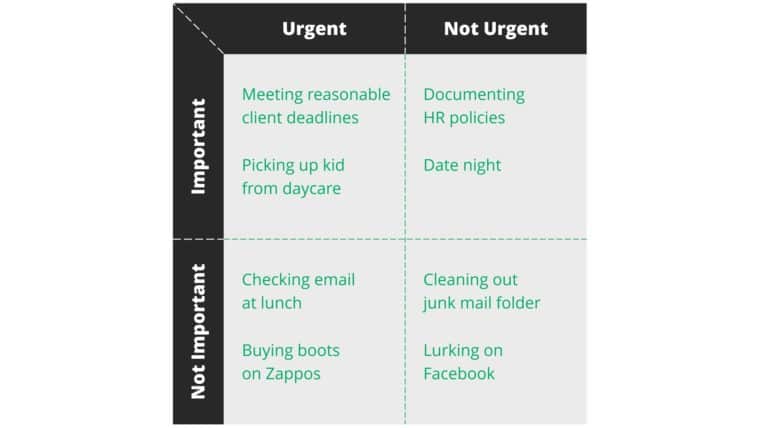
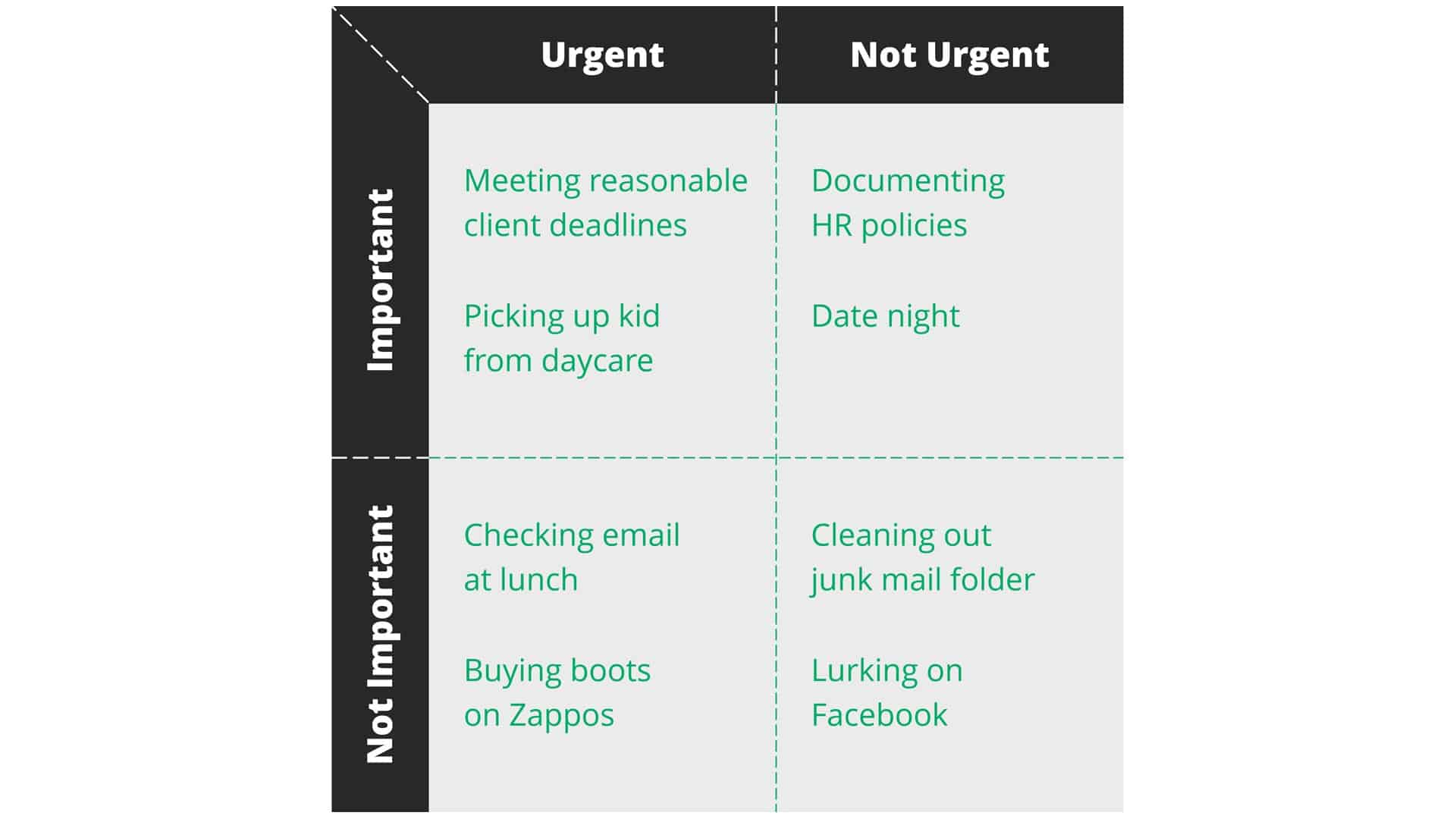
We’re just finishing up a classic four-square framework for a client—the ubiquitous diagram favored by MBAs where you place things along a two continuums, left-to-right and top-to-bottom, always aiming to direct the eye of your viewer to that enviable position of the upper right-hand quadrant. It’s popular because it’s good, and provides a clear method to quickly visualize a landscape of options based on a few key criteria. But like a good pop song, when you’ve heard it one too many times, the shine is off and it gets annoying (Hotline Bling, anyone?).

The exercise reminded me of my favorite four-square, one I always go back to when things get busy. The Eisenhower Decision Matrix reminds us to make sure we’re spending our precious time wisely, and getting the right things done. The truth is we all spend time in each quadrant and that’s not going to change, but like all things tempting, the skill is in the balance of not overindulging in any one quadrant.  In general, we spend too much time in urgent/not-important (checking email on our phone as we walk to the bathroom) and not enough time in important/not-urgent (date night).

How do you parse your day?

bring on the waterworks

09/30/2015

Bring on the waterworks

By Abby Breckenridge

bring on the waterworks

A few weeks ago, a good friend reached out to me and another friend about a mentoring situation she was struggling with at work. Her mentee was a young, ambitious, well-respected female developer in a mostly male company. She had recently cried in front of more senior colleagues in response to some reasonable feedback, and was feeling ashamed and regretful. She wanted advice on what she should do, not wanting to build a reputation as “the girl that cries.”

After much discussion about the pros and cons of crying at work, we basically came to this:

Shake it off.

Crying may not be the best way to get things done at work, but it happens. I’ve certainly done it, more than once. After a quick browse through the internet, it became clear that we are not alone in our advice. Apparently Sheryl Sandberg declared its ok to cry at work in 2013.

“Look, I’m not suggesting that the way to get to the corner office is to cry as much as possible. Nobody is going to publish the next Seven Habits of Highly Effective People and say that crying is one of them. But I am saying that it happens…Rather than spend all this time beating ourselves up for it, let’s accept ourselves. OK, I cried, life went on. And I think that’s part of the message of Lean In, like we are human beings, we are emotional beings and we can be our whole selves at work.”

In all of our job descriptions at 2A, we include this clause:

We like what we do, and we want to work with people who are excited to be at work, and nice to be around.  At the end of the day, work relationships are a big portion of our lives, and we want them to be rewarding and enjoyable.

To me, that means we want real whole people on our team. And if you’re a person who cries when you get emotional, bring it on.

Parental leave

09/03/2015

When parental leave gets real

By Abby Breckenridge

Parental leave

My husband isn’t technically a millennial, but he’s close. That, and the fact that we’re juggling a new baby and two careers made me especially interested in Claire Cain Miller’s “Millennial Men Aren’t the Dads They Thought They’d Be” in the New York Times a few weeks back.

Miller writes that while millennial men aspire to more egalitarian relationships—more so than any other generation—as they advance in their careers, they adopt more traditional roles.  She attributes the shift to unsupportive workplace policies and a gender divide in the way workers respond to the pressures of employment.

“The research shows that when something has to give in the work-life juggle, men and women respond differently. Women are more likely to use benefits like paid leave or flexible schedules, and in the absence of those policies, they cut back on work. Men work more,” Miller writes.

My husband works for a small architecture firm, and they’ve generously let him cut his hours to accommodate spending Wednesdays with our son. Similar to what many working moms have experienced for decades, he already feels the tug of what a reduced schedule means for his opportunities and perception at work.

According to John Oliver, the US and Papua New Guinea are the only countries that require no paid maternity leave. And while there’s been some good news recently about strengthening of family workplace policies with Microsoft and Netflix expanding parental leave, we obviously have a long way to go. In the meantime, I am grateful to have an almost-millennial partner who’s committed to working through the challenges of balancing family and work, and taking advantage of modern workplace policies that allow him to prioritize parenting.

Maybe by the time my son enters the workforce, we can come up with something more useful to offer parents than a free meal at Hooter’s on Mother’s Day.

Washington's Wild West

05/12/2015

Washington’s Wild West

By Abby Breckenridge

Washington's Wild West

For years I’ve romanticized the idea of running a business in the old Wild West. There’s something so alluring about the unencumbered entrepreneurship and creativity of a frontier town—see an unmet need, come up with a creative way to meet it, then make it rich. Like selling pickaxes in Deadwood, but without the syphilis and gun fighting.

The daylighting of cannabis sales may be as close as we come to a new market that doesn’t involve product innovation—pot has been around for ages, but for the most part, its trade has functioned outside of legal markets. While Washington State Initiative 502 legalized the sale of cannabis products for recreational use passed in 2012, 2015 marked the beginning of the fun phase for marketers—demand has finally surpassed supply, and telling a story that differentiates your cannabis brand has become a key to success.

Sure, prices are dropping (the average price of legal pot is now $12 per gram, down from $30 last summer), but that’s not the only way to set your product apart. That’s why we’re excited to partner with our client in the modern-day Wild West as they rollout their premium cannabis products. Stay tuned for more details about this new brand as it hits the shelves in a pot shop near you.