Blog

04/24/2023

Meet Chris Stetkiewicz, tech translator at Microsoft Research

Full story

By Kate Forster

decorative image

Telling stories about robotics and artificial intelligence in an engaging and attention-grabbing manner is a rare talent. Chris Stetkiewicz, 2A Embedded Consultant (EC), has been applying this talent for the past two years as a writer and editor at Microsoft Research—one of only a few computer science research centers outside academia.

2A’s ECs are highly skilled and experienced professionals who function as contracted members of our clients’ teams, and Chris is one of our most accomplished. He and I recently sat down to talk about writing contests, robotics, and dog parks. Here’s a snippet from our conversation.

Kate: With all the groundbreaking work going on, Microsoft Research sounds like an incredible place to work.

Chris: It really is. I feel lucky to get to work with some of the most accomplished people in technology and science. I learn from them every day, and it makes my job interesting. I also work alongside some very talented writers and content creators, and I learn a lot from them too.

Kate: Working with some of the most renowned computer scientists in the world must be exciting, and slightly intimidating I imagine. How do you see your role?

Chris: I find it inspiring. For my part, I bring an external perspective and an appreciation for how people think about technology outside the company, which the researchers don’t always have. I help them understand what they’re doing in the larger context.

Sometimes I craft a story that isn’t exactly the story we were initially setting out to tell, but it’s an effective story to tell for our audience.

Kate: Can you share an interesting story you’ve worked on?

Chris: I recently completed a story on robotics. It’s about a technology called MoCapAct, which is a dataset intended to make it easier for robots to physically move the way people do.

There’s an existing database called MoCap, which stands for motion capture, in which technology is used to track and record people’s physical motions. It’s used to create animated films or computer-generated imagery (CGI). But it’s a lot harder to get robots to move in precisely the same way that people do. MoCapAct—motion capture in action—solves this problem.

Kate: You’ve been writing and reporting in some form or another over your entire career. What first drew you to writing?

Chris: Oh, I’ve been writing since I was a little kid, and I always enjoyed it. In elementary school, I would enter every writing contest and always win. When I took a high school journalism class, I had a letter to the editor published by a local newspaper. After that I was hooked! I knew I wanted to be a journalist. I would read three of our local newspapers every day, cover to cover.

Kate: Seems like news and writing are in your DNA. I understand you started your career as a journalist for news organizations. Now you’re writing for a tech company. What connections do you see between the two?

Chris: A good story is a good story, no matter who’s telling it. The only difference is how the content is delivered. At Microsoft Research, the biggest part of my job entails writing and editing blog posts and social media content, but I’ve also written video scripts, built newsletters, and launched new content programs.

Kate: Sounds like you need to be pretty versatile. On a different note, I know you‘re a dog owner. In fact, your dog has made some cameos in video meetings we’ve both been in.

Chris: Heh. It’s as if he arrives on cue. He knows when it’s a bad time to come and interrupt me, and there he is.

Kate: Ha ha. As a new dog owner, I can relate. Do you have any recommendations for good dog parks in the area?

Chris: I recommend the dog park at Marymoor Park in Redmond. It’s near the Microsoft campus, and it’s got great swimming options. There are multiple spots where you can go on down to the Sammamish River and let your dog take a dunk or get a drink.

Kate: Hmm. I’ve yet to discover if my dog likes the water. Sounds like there’s a good opportunity to find out. Thanks.

Chris: You’re welcome. This park has a way of turning unsuspecting canines into water-loving dogs. Watch out.
_________________________________________________________________________________________________________

Interested in becoming an EC? Check out our open roles, or submit a General Job Inquiry if you don’t see exactly what you’re looking for.

Want to hire an Embedded Consultant? Learn more here.

02/13/2023

How we write job descriptions that feel welcoming—to everyone 

Full story

By Nora Bright

Image of a unicorn with a horn that's a pencil with a job description flowing from it in rainbow colors

Image by Thad Allen

We know our people are what make 2A special—so we take hiring seriously. For the marketing agency, we need folks who can understand complex technology AND craft beautiful prose or designs. For our Embedded Consultants, our clients are often seeking a specific skillset that takes some serious 2A elbow-grease to find. On top of that, we’re always looking to build a stronger and more diverse team by hiring individuals who bring new perspectives and come from different backgrounds. 

Last year we decided to research the latest and greatest strategies for writing job descriptions that attract a diverse talent pool—and see how we could take our own job postings to the next level. Read on for our top 3 tips. You may discover something new! 

Use growth mindset language 

Fascinating research shows job descriptions that use growth mindset language instead of fixed mindset language are twice as likely to result in a woman being hired. What’s a growth mindset? It’s a term coined by Carol Dweck that describes the belief that if you work hard, you can grow your talents. Language like “hard-working,” “curiosity” or “thoughtful” reflects that. 

The opposite of a growth mindset is a fixed mindset—the perspective that talent is something you’re born with (or not). Examples of fixed mindset language would be “genius” or “super star.” Words like this can make candidates decide not to apply for the role at all, because they don’t feel like they’ve got it all figured out yet (who does?). 

At 2A, we hold growth mindset ideals close to our hearts but realized our job descriptions had plenty of fixed mindset words. We combed through our job descriptions and changed phrases like “expert” to “passionate.” We love that our job descriptions better reflect our values. 

Cool it on the requirements 

You need someone who can write a 500-word blog article in under 20 minutes—while juggling a litter of kittens? We’ve all read job descriptions with requirements that seem to target someone who doesn’t really exist (we’ve got a phrase for that in recruiting, unicorn candidates.) Not only are these job descriptions unrealistic, but they can also scare people off from applying who don’t meet every single bullet. We know from research that women are less likely to apply if they don’t meet all the requirements in a job description. 

Instead of wish list of every attribute, we culled our requirements to a concise list of skills and experiences that are essential for getting the job done. 

If you’ve got it, flaunt it (great benefits, that is) 

Benefits like parental leave and health insurance are an important way that companies care for their employees. Including your benefits in a job description is a great way to help candidates from different backgrounds see themselves thriving personally and professionally at your company.  

We have pretty sweet benefits here at 2A. In addition to great health, dental, and vision insurance, plus a generous PTO plan, we also have an enrichment stipend, donation matching, and more. Where were these benefits in our job descriptions? Nowhere, and candidates needed to click a few times to find any information about them. Now our benefits are easy to find along with the role’s salary range. 

So, are you ready to see what it looks like when growth mindset language, concise requirements, and show-stopping benefits come together? Check out our careers page

09/30/2022

Get big-time interest in your short-term job opening

Full story

By Nora Bright

decorative image

Image by Suzanne Calkins

Hiring for short-term roles can be tricky. Especially now that the labor market is cooling off, candidates are warier about taking on short contracts knowing they’ll be back on the (possibly less favorable) job market soon.

Luckily, we’ve learned a thing or two over the years from sourcing talented embedded consultants for our clients’ short-term roles, ranging from parental leave coverage to quick-turn projects. Whether you’re working with an agency or not, these tips can help you land a stellar hire that can make a major impact on a reduced timeline.

  1. Write a clear and realistic scope of work

When a role’s timeline is limited, the position’s responsibilities and goals must be tightly defined. A clear scope will not only set engagements up for success, but also help attract a strong candidate pool. Candidates (especially the most experienced ones) will sniff out an ill-defined or unrealistic scope from miles away—and might withdraw from the interview process or not apply in the first place. Sharing a clear scope of work in the job description and during interviews will assure candidates that they can be successful in the role and deliver the results you expect.

  1. Know what skills and experience are essential—and how that aligns with your budget and resources

We find that candidates interested in short-term roles often fall into two camps. Either they’re experts with a long track record of completing the role’s responsibilities, or they’re early in their careers and eager to ramp up their skills quickly in a fast-paced environment. The experts tend to hit the ground running but come at a high price point (understandably so). Meanwhile, the newer folks generally need more support and sometimes need a reduced project scope. However, their overall rate is less.

Ask yourself what skills and experience are truly necessary for the role and whether you have the budget and support to set them up for success.

  1. Decide on an interview process and proceed quickly

Before getting started, decide how many interview rounds there will be and who will join from your team. Sharing these steps upfront with candidates will show that your team is organized and ready to bring them on.

Keeping the interview process rolling along will reduce the risk that you lose your dream candidate to another opportunity. With candidates often interviewing for multiple roles, moving quickly will give you an advantage.

If you’ve got a short-term role to fill, we’ve got your back. Reach out to learn more!

08/25/2022

Hiring managers: 4 questions to ask when choosing a consulting agency for contract roles

Full story

By Nora Bright

decorative image

Image by Emily Zheng

Tech workers have a lot of options to choose from when it comes to their next gig—and for experienced contractors considering their next position, they’re discerning not just about the role, but about the consulting agency they’ll be employed by. Agencies can be a lot more than just a way for contractors to get paid—they can also provide benefits like health insurance and 401k plans, and crucial support like professional development opportunities and coaching.

If you’re looking for great talent to join your team on a contract basis, make sure you’re working with an agency that has what it takes to attract an experienced and diverse talent pool. Ask these four questions to determine if an agency can deliver the best talent out there.

1. What benefits and PTO do you offer your employees?

In our recent survey of Microsoft contractors, 94% of respondents said an agency’s PTO policy is important in deciding whether to accept a position, and 80% said the same about medical, dental, and vision insurance. Other benefits to ask about include 401k plans and whether the firm provides the software needed for their engagements (or if contractors are expected to buy it themselves).

2. How do you support your employees during an engagement?

Does the agency meet with employees regularly, or “set it and forget it”? Agencies can offer crucial support to their employees—coaching them on navigating their roles and hitting the ground running in a new position.

3. What professional development opportunities do you offer?

According to our survey, contractors feel their biggest challenge at work is a lack of career growth. Some firms offer a professional development budget or internal workshops and events that can keep talent engaged and retained on your team.

4. What is your DEIB (Diversity, Equity, Inclusion, and Belonging) strategy?

Agencies with an effective diversity recruiting strategy have a more extensive and diverse talent pool to choose from when sourcing candidates for your role. Working with an agency that takes diversity recruiting seriously will up the likelihood that your contractor will make an impact and provide a fresh perspective on your team. An agency’s DEIB strategy could include inclusive language in job descriptions, posting on job boards with diverse talent, and culture initiatives.

Ready to bring on your next great hire? Learn more about our Embedded Consultants.

04/28/2022

Part II: We love our Embedded Consultants, and the feeling is mutual

Full story

By Nora Bright

Now that you know how consulting agencies impact the experience of Microsoft contractors, I’ll let you in on a little secret: some agencies have a bigger, more positive impact than others. And, according to our survey, 2A comes out on top. Read on to learn what 2A’s Microsoft contractors—or Embedded Consultants (ECs), as we call them—had to say about us and what benefits and perks we offer that made them more satisfied than folks at other agencies.


Embedded Consultants (ECs) love working at 2A
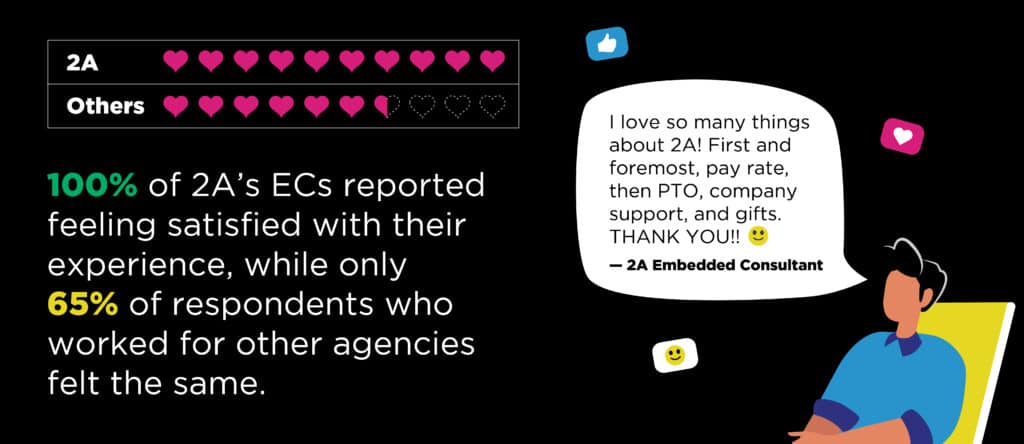
When it comes to the agency experience, 2A ECs were more satisfied than contractors from other firms.


Working at 2A leads to a better Microsoft experience
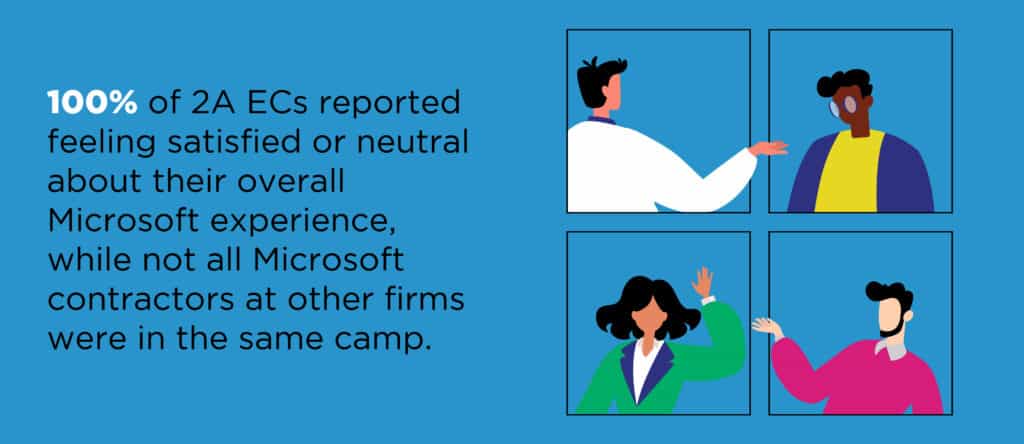
2A ECs were also more satisfied with their Microsoft experience than contractors from other firms.


Our benefits take the cake
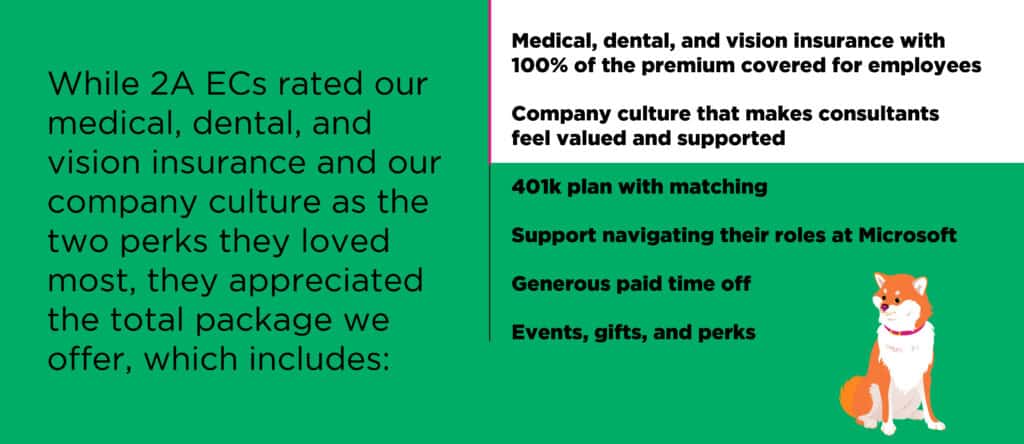
There’s a lot to love about 2A, but our insurance benefits and company culture are the favorites.

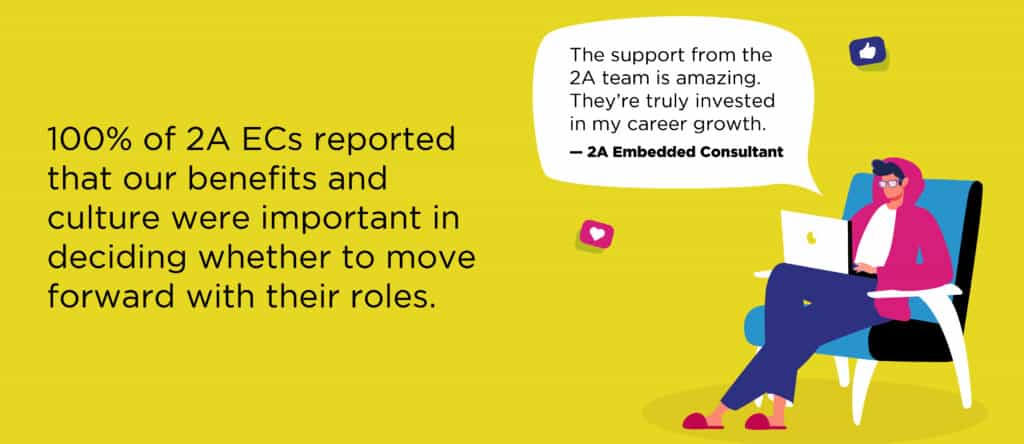
Our superior benefits and company culture helped 2A ECs decide to say yes to their Microsoft contractor opportunities.


Ready to love your agency?
Whether you’re hiring a contractor or ready to embark on a new role with Microsoft, having the right agency behind you makes all the difference. Learn how 2A helps hiring managers and contractors shine.

Images by Guangyi Li

03/23/2022

Part I: Consulting agencies make a big impact on the Microsoft contractor experience from start to finish

Full story

By Nora Bright

Part I: Consulting agencies make a big impact on the Microsoft contractor experience from start to finish

Image by Guangyi Li

At 2A, we know it takes exceptional people to deliver exceptional work—and attracting those top performers starts with creating a top-notch employee experience. That’s true whether we’re talking about the marvelous marketers and creatives that craft client deliverables as part of our marketing agency, or our extraordinary Embedded Consultants.

Here you might ask, what exactly is an Embedded Consultant? ECs, as we call them, are highly skilled and experienced individuals who function as contracted members of our clients’ in-house teams, using their considerable talents to help get critical projects over the line. Our ECs are experts in partner engagement, marketing and project management, business operations, and more, and all share 2A’s commitment to delivering exceptional results.

While we’ve placed ECs in a number of top tech companies, our Microsoft EC practice has really taken off. As our practice grows, it feels only natural to take a step back and evaluate—as an agency, are we delivering the experiences and benefits that help our ECs shine in their Microsoft roles? And, taking a further step back, how much of an impact does 2A—or any agency—have on the EC experience anyway?

To find out, we surveyed a diverse group of 50+ marketers, project managers, and other professionals with several months to more than 12 years of experience as Microsoft contractors. Our respondents included previous 2A ECs as well as contractors who have never worked for us.

So, what did we learn? Read on for the details, but here’s a sneak peak: agencies impact the experience of Microsoft contractors at every stage, from whether they decide to accept a role in the first place to how they feel when their time at Microsoft is over.

Go or no-go: Consulting agency benefits and culture are major factors in deciding whether to accept a new contractor role.

98% of respondents said the agency associated with the opportunity impacted their decision to accept a position 

94% of respondents said the agency’s PTO policy was an important factor in deciding whether to accept a position

80% of respondents said these factors were also important in their decision:

  • Medical, dental, and vision insurance
  • Agency company culture
  • Agency ability to provide support in navigating their role

And when it’s over: When looking back on their time at Microsoft, ECs report that their relationship with their agency played a significant role in their overall take on the experience. 

  • Microsoft contractors who were unsatisfied with their agency were 3x more likely to also be unsatisfied with their overall experience at Microsoft 
  • 2/3 of Microsoft contractors who were unsatisfied with their agency reported poor company culture and lack of support with navigating their roles as the top reasons

Looking forward: Agencies can make or break opportunities for both Microsoft hiring managers and contractors. Does your agency provide these benefits Microsoft contractors love?

  • Medical, dental, and vision insurance benefits
  • Generous paid time off
  • 401k plan with matching
  • Company culture that makes consultants feel valued and supported

Stay tuned for part two of this blog series, where we’ll reveal how 2A stacks up against other agencies and why it matters. In the meantime, whether you’re a hiring manager or could be our next EC, we’d love to tell you more about what makes 2A different.